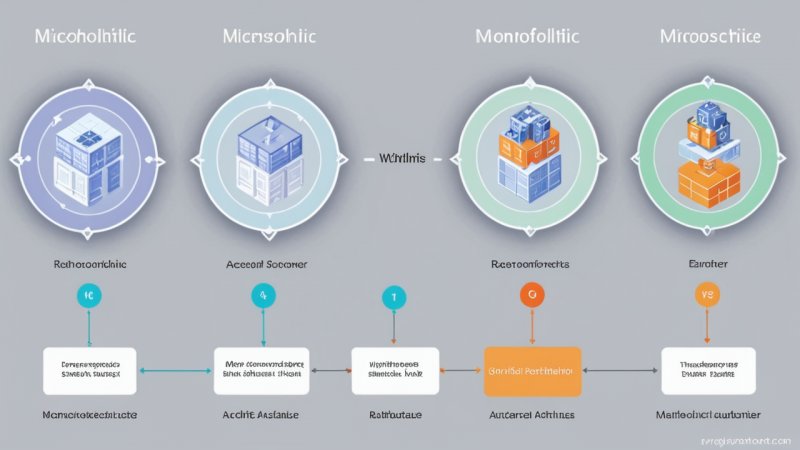
In the ever-evolving landscape of software development, the choice of architecture can profoundly influence a system's flexibility, scalability, and maintainability. Two primary architectural styles dominate the discussion: microservices and monolithic architecture. Each approach has its own set of advantages and disadvantages, and understanding these can significantly impact the success of a software project. This article delves into the characteristics of both architectures, evaluates their strengths and weaknesses, examines real-world applications, and provides guidance on choosing the right architecture for your organization.
Understanding Monolithic Architecture
A monolithic architecture is a traditional approach where all components of an application are combined into a single, unified codebase. This means that the user interface, business logic, and data access layers are all interconnected and run as a single process. Key characteristics of monolithic architecture include:
- Simplicity: Monolithic applications are straightforward to develop, deploy, and manage, especially for small teams and projects.
- Performance: Since all components are housed in one codebase, communication between different parts of the application happens through direct method calls, which can enhance performance.
- Deployment: A monolithic application is deployed as a whole, which simplifies the deployment process but can lead to challenges in scaling individual components.
Advantages of Monolithic Architecture
- Easy to Develop: With a single codebase, development teams can work on the same platform without worrying about inter-service communication.
- Lower Overhead: Monolithic applications typically incur less overhead than microservices due to fewer network calls and simpler deployment processes.
- Well-Suited for Small Projects: For small teams or startups, a monolithic architecture often allows for quicker iterations and faster time to market.
Disadvantages of Monolithic Architecture
- Scalability Issues: Scaling a monolithic application can be challenging, as it often requires scaling the entire application instead of just the components that need it.
- Longer Development Cycles: As applications grow, the codebase can become unwieldy, leading to slower development cycles and increased difficulty in adding new features.
- Single Point of Failure: A failure in any part of a monolithic application can lead to the entire application going down, which can impact uptime and reliability.
Exploring Microservices Architecture
Microservices architecture, in contrast, breaks down an application into smaller, loosely coupled services, each responsible for a specific business capability. These services communicate through APIs and can be developed, deployed, and scaled independently. Key characteristics of microservices architecture include:
- Decentralization: Each microservice can be built using different technologies and programming languages, allowing teams to choose the best tools for their specific tasks.
- Independent Deployment: Each service can be deployed independently, enabling faster iterations and more frequent releases.
- Resilience: If one service fails, it does not necessarily bring down the entire application, enhancing overall system reliability.
Advantages of Microservices Architecture
- Scalability: Individual services can be scaled independently based on demand, allowing for more efficient resource utilization.
- Flexibility: Teams can adopt new technologies or frameworks for specific services without affecting the entire application.
- Faster Time to Market: Parallel development and deployment of services can lead to quicker releases and an enhanced ability to respond to market changes.
Disadvantages of Microservices Architecture
- Complexity: Managing multiple services can introduce complexity in terms of deployment, monitoring, and inter-service communication.
- Network Latency: Communication between microservices often occurs over the network, which can introduce latency and impact performance.
- Higher Initial Setup Costs: The need for infrastructure to support multiple services can lead to increased initial costs and overhead.
Use Cases and Real-World Applications
Understanding when to use a monolithic or microservices architecture can be significantly influenced by the specific use case. Here are some scenarios for each architecture:
When to Use Monolithic Architecture
- Small Scale Applications: For small applications with limited functionality and a single development team, monolithic architecture can simplify the development process.
- Short-Term Projects: If an application is intended for short-term use, a monolithic design may allow for quicker deployment and iteration.
- Simple Business Logic: Applications that do not require complex scaling or high availability may function well with a monolithic approach.
When to Use Microservices Architecture
- Large Scale Applications: For large applications with varying functionalities and high traffic, microservices can allow for scalable and efficient management.
- Rapidly Changing Requirements: If the application needs frequent updates and features, microservices can enable faster iterations.
- Distributed Teams: Organizations with distributed teams can benefit from microservices, as different teams can work on different services independently.
Implementation Considerations
Making the switch from one architecture to another or deciding on a new architecture involves careful consideration and planning. Key factors to keep in mind include:
- Team Structure: Evaluate your team's skill set and how they align with the architectural style. Microservices may require more specialized skills.
- Current Infrastructure: Consider your existing infrastructure and whether it can support the chosen architecture.
- Long-Term Vision: Align the architectural decision with the long-term goals of your organization and project.
Conclusion
Choosing between microservices and monolithic architecture is a crucial decision in any software development project. While monolithic architecture can provide simplicity and speed for smaller projects, microservices offer flexibility and scalability for larger, more complex applications. Evaluating the needs of your project, your team's capabilities, and your long-term goals will guide you in making the best architectural choice. By understanding the strengths and weaknesses of each approach, organizations can position themselves for success in an increasingly competitive digital landscape.