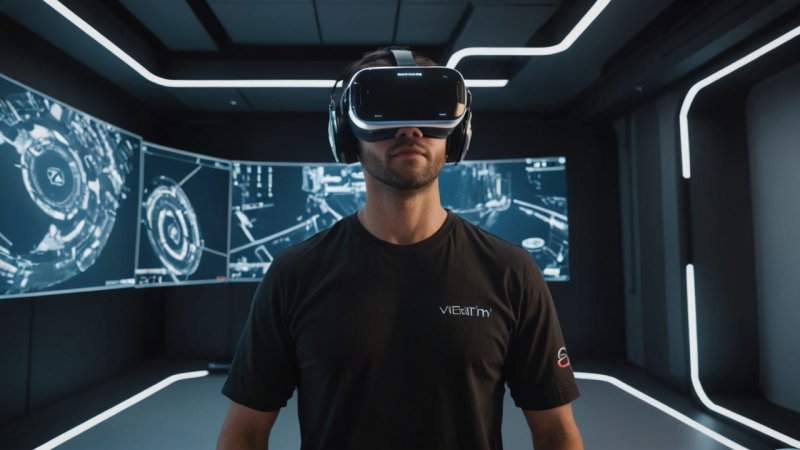
As virtual reality (VR) technology continues to evolve, the demand for sophisticated software development techniques becomes more critical. Developers are constantly exploring new methods to create immersive experiences that engage users and push the boundaries of what VR can achieve. This article delves into several innovative techniques and trends in software development for virtual reality.
One of the key techniques in VR software development is the use of real-time rendering. This process allows developers to create highly detailed and interactive environments that respond instantly to user actions. Real-time rendering leverages powerful graphics processing units (GPUs) to produce high-quality visuals that enhance the immersive experience. Developers often use engines like Unity and Unreal Engine, which provide robust tools for real-time rendering, making it easier to create lifelike simulations.
Motion tracking is another crucial aspect of VR development. Accurate motion tracking enables users to interact with virtual environments naturally. By utilizing sensors and cameras, developers can capture the user's movements and translate them into VR space. This technology is pivotal in creating experiences that feel intuitive and responsive, allowing users to engage with the virtual world as if they were physically present.
In addition to rendering and motion tracking, artificial intelligence (AI) is becoming increasingly important in VR. AI can enhance user interactions by making virtual characters more responsive and lifelike. For instance, AI-driven NPCs (non-playable characters) can adapt to players' actions, providing a dynamic experience that keeps users engaged. Furthermore, AI can help optimize performance, ensuring that VR applications run smoothly even on lower-end hardware.
Another significant trend in VR software development is the incorporation of cloud computing. By leveraging cloud technology, developers can offload heavy processing tasks, enabling more complex simulations and interactions. This approach also allows for easier updates and scalability, as users can access the latest versions of VR applications without needing manual installations. Cloud computing facilitates collaborative VR experiences, where multiple users can interact within the same virtual environment in real time.
Moreover, cross-platform development is gaining traction in the VR space. Developers aim to create applications that can run on various devices, including VR headsets, mobile phones, and PCs. This approach broadens the audience and increases accessibility, allowing a larger number of users to experience the same VR content. Tools like Unity and WebVR offer frameworks that simplify cross-platform development, making it easier to reach diverse user bases.
In conclusion, the field of software development for virtual reality is marked by rapid advancements and innovative techniques. Real-time rendering, motion tracking, artificial intelligence, cloud computing, and cross-platform development are key trends shaping the future of VR applications. As developers continue to explore these techniques, we can expect to see even more immersive and engaging experiences that redefine how we interact with digital content.