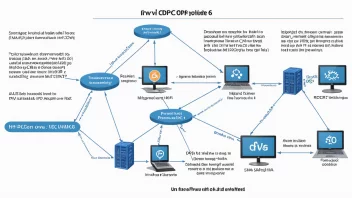
Rapid Spanning Tree Protocol (RSTP) is a network protocol designed to enhance the reliability and efficiency of Ethernet networks by preventing loops and ensuring redundancy. In today’s digital age, where network uptime is critical, understanding RSTP is essential for network engineers and IT professionals. This article outlines the key aspects of RSTP, its benefits, and its role in network redundancy.
What is RSTP?
Rapid Spanning Tree Protocol, defined by IEEE 802.1w, is an evolution of the original Spanning Tree Protocol (STP). It was developed to reduce the time it takes for a network to converge after a topology change, thus minimizing downtime. RSTP achieves this by utilizing a state machine that allows for faster transition of ports between states.
Key Features of RSTP
RSTP introduces several enhancements over the original STP, including:
- Port States: RSTP includes five port states: Discarding, Learning, Forwarding, and two additional states (Alternate and Backup) that allow for faster convergence.
- Rapid Transition: RSTP allows ports to transition directly to the Forwarding state from the Discarding state, bypassing the Learning state, which significantly speeds up the process.
- Edge Ports: Ports connected to end devices can be designated as edge ports, which immediately transition to Forwarding state, reducing convergence time.
How RSTP Works
RSTP operates using a set of rules and messages to maintain a loop-free topology. Key operational concepts include:
- Bridge Protocol Data Units (BPDUs): RSTP uses BPDUs to communicate between switches. These messages contain information about the network topology and are sent every 2 seconds by default.
- Role of Ports: Each port on a switch has a role (Root, Designated, or Non-Designated) that determines its function within the topology.
- Topology Change Notification (TCN): When a network change occurs, RSTP sends a TCN to all switches to initiate a re-convergence process.
Benefits of Implementing RSTP
Implementing RSTP offers numerous advantages for network management:
- Reduced Downtime: With faster convergence times, RSTP minimizes network downtime and improves reliability.
- Scalability: RSTP can support larger networks more efficiently than STP, making it suitable for enterprise-level environments.
- Compatibility: RSTP is backward compatible with STP, allowing for a gradual transition in mixed environments.
Case Studies: RSTP in Action
Various organizations have successfully implemented RSTP to enhance their network reliability:
- University Network: A large university improved its campus network resilience by deploying RSTP, which allowed for seamless connectivity across multiple departments during network upgrades.
- Data Center: A data center integrated RSTP to ensure high availability for its server farms, resulting in reduced service interruptions and improved performance metrics.
In conclusion, RSTP plays a crucial role in ensuring network redundancy and reliability. By understanding its features and benefits, network professionals can implement RSTP effectively to minimize downtime and enhance the efficiency of their networks. Whether for educational institutions, enterprises, or data centers, RSTP is a vital protocol that addresses modern networking challenges.