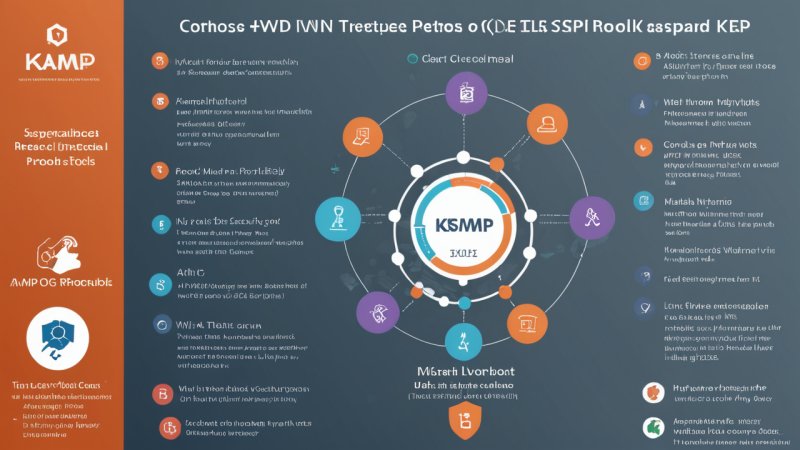
In the realm of Virtual Private Networks (VPNs), securing data transmission is paramount. Two protocols that play crucial roles in ensuring this security are the Internet Security Association and Key Management Protocol (ISAKMP) and the Internet Key Exchange (IKE). Both protocols are designed to establish security associations and manage cryptographic keys, but they do so with differing approaches and functionalities. This article aims to dissect the features, advantages, and drawbacks of ISAKMP and IKE, providing a comprehensive comparison that will help you understand their respective roles in VPN security.
Overview of ISAKMP
ISAKMP is a framework for security association (SA) management. It defines the procedures for establishing, negotiating, and managing SAs, which are crucial for secure communication. ISAKMP operates independently of the underlying encryption and authentication mechanisms, making it a flexible and adaptable protocol.
Pros of ISAKMP
- Flexibility: ISAKMP’s protocol is not tied to any specific encryption algorithm, allowing for a wide range of cryptographic methods.
- Standardization: As part of the IETF standards, ISAKMP is widely recognized and implemented across various platforms.
- Compatibility: ISAKMP can work alongside other protocols, enabling interoperability among different systems.
Cons of ISAKMP
- Complexity: The flexibility of ISAKMP can lead to complex implementations, requiring careful planning and configuration.
- Management Overhead: As a framework, ISAKMP requires additional mechanisms for key management, which can increase administrative effort.
Overview of IKE
Internet Key Exchange (IKE) is a key management protocol that operates over ISAKMP. It simplifies the establishment of security associations by automating the negotiation of cryptographic parameters and keys. IKE has evolved through several versions, with IKEv2 being the most current and widely adopted.
Pros of IKE
- Simplification: IKE automates the negotiation process, reducing the complexity of establishing secure connections.
- Efficiency: IKEv2 improves performance by reducing the number of messages exchanged during the SA establishment process.
- Mobility and Multihoming Support: IKEv2 includes features that support mobile devices and multihomed environments, enhancing VPN usability.
Cons of IKE
- Dependency on ISAKMP: IKE relies on ISAKMP for its foundation, which means that its flexibility can be limited by ISAKMP’s complexity.
- Implementation Variability: Different implementations of IKE can lead to compatibility issues, particularly between vendors.
Comparison of Key Features
| Feature | ISAKMP | IKE |
|---|---|---|
| Protocol Type | Framework for SA management | Key management protocol based on ISAKMP |
| Complexity | Higher complexity due to flexibility | Lower complexity due to automation |
| Efficiency | Less efficient; relies on external mechanisms | More efficient; fewer messages needed |
| Mobility Support | Limited mobility support | Enhanced mobility support in IKEv2 |
| Standardization | Widely standardized | Widely standardized, but variations exist |
Use Cases and Applications
Both ISAKMP and IKE are utilized in various scenarios, but their applications might differ based on the needs of the organization.
When to Use ISAKMP
ISAKMP can be advantageous in situations where flexibility and compatibility with a wide range of cryptographic algorithms are needed. Enterprises that require custom security implementations or have legacy systems may find ISAKMP to be a suitable choice.
When to Use IKE
Organizations looking for a streamlined approach to key management should consider IKE, particularly IKEv2. It is ideal for environments that prioritize efficiency and mobility, such as remote work scenarios or mobile device management.
Case Studies
ISAKMP in Action
One notable example of ISAKMP’s application is in legacy systems within government networks, where a variety of encryption protocols are used due to historical requirements. In this context, ISAKMP’s adaptability allows for secure communications without locking the organization into a single cryptographic method.
IKE in Action
A leading financial institution adopted IKEv2 to enhance the security of its remote access VPN. By utilizing IKEv2’s streamlined negotiation process and mobility features, the institution improved its user experience and reduced connection drop rates for mobile employees.
Conclusion
In summary, both ISAKMP and IKE play pivotal roles in VPN security, each with its distinct advantages and drawbacks. ISAKMP offers flexibility and compatibility, making it suitable for complex environments, while IKE simplifies the key management process and enhances efficiency, particularly for modern applications. Ultimately, the choice between ISAKMP and IKE will depend on the specific needs and infrastructure of the organization. For those seeking a straightforward implementation with robust mobility support, IKEv2 is likely the preferred option. However, for organizations with specific legacy requirements or those needing extensive customization, ISAKMP remains a valuable tool in the arsenal of network security protocols.